
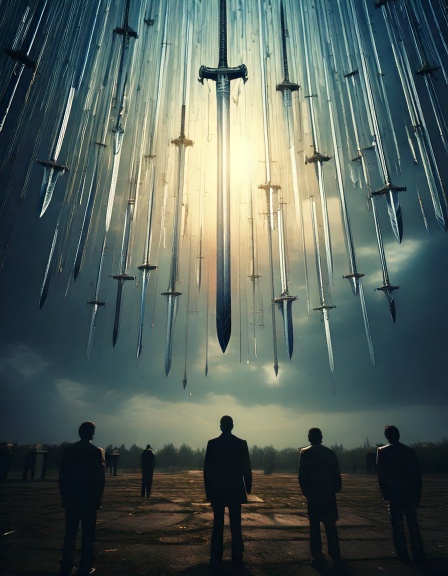
Some years feel like storms. This one feels like standing under a sky full of swords—each one glinting, dangling, humming with possibility and threat. And yet we still show up to work, swipe our cards, sit at our desks, smile at Teams calls, and hope we’re not next – the hanging sword of layoffs. It feels dramatic to call it that, I know. But honestly, isn’t that how it feels? Like the classic Sword of Damocles, suspended by a single horsehair, wobbling over our heads while we pretend to focus on deadlines, campaigns, deliverables, KPIs, and whatever else is on our weekly dashboards.
Hope has started to feel like those plastic plants in reception—nice to look at, but not exactly alive. Across India, and honestly, across the world, layoffs have become the new ambient soundtrack. A low, persistent hum. And if you’re anywhere near the creative, tech, or media industries, it’s more like a drumline. This year alone, India has seen more layoffs than the number of jobs created.
Let that sink in.
AI arrived like a glamorous new guest at a party that was already tense. Everyone looked at it, whispered its name, both thrilled and terrified. Companies grabbed it like a shiny excuse:
“Efficiency!”
“Future!”
“Optimisation!”
But let’s be honest—AI is just the newest poster child. A convenient cover story.
Of course, AI gets blamed for most of it. And yes, AI has changed workflows in ways we didn’t imagine even three years ago. Automation has reduced dependency on manpower across industries. Tools are replacing entire support processes. Creative teams are shrinking. Strategy functions are evolving into hybrid roles.
But is AI really the villain? Or is it just the most convenient one to point at?
The uncomfortable truth is that India’s economy is wobbling in ways we don’t talk about enough. The public sector isn’t generating new jobs at the scale it once did. The private sector is scrambling under margin pressure, cost optimisations, and global headwinds. And when survival becomes the agenda, layoffs become the easiest lever to pull.
We’ve seen this play out brutally this year. IT giants—the very companies that once symbolised upward mobility—have laid off more people this year than perhaps ever before. And they still haven’t stopped.
And now with the IPG-Omnicom consolidation, more heads will roll. Not because people aren’t talented. Not because people aren’t hardworking. But because balance sheets are unforgiving. Trust me—consolidations sound sexy only in business papers. On the ground, they usually mean:
People
Will
Lose
Jobs.
And every time I read those headlines or hear someone whisper about layoffs in the pantry, the same question rises in me:
Where will they go?
What will they do?
We love saying things like “You can always upskill,” “Start a YouTube channel,” “Become a creator,” “Start freelancing,” as if these are universal backup plans. But let’s be honest. Not everyone can pick up a camera and transform into a charismatic content creator. Not everyone can magically “crack the algorithm.”
Today’s digital landscape is more crowded than a Mumbai local at rush hour. People are creating content faster than we can consume it. Breaking through that clutter is less about talent and more about timing, luck, and sheer persistence. And even then, the odds are thin.
What about the mid-career folks? People in their 30s and 40s with mortgages, rent, school fees, aging parents, medical bills?
What about the fresh graduates whose dreams meet a job market with fewer chairs than players?
We rarely talk about what layoffs actually do to a person. The loss of identity. The hit to self-worth. The slow erosion of confidence. The awkward conversations with family. The fear of being left behind.
When an organisation calls it “restructuring,” it sounds strategic.
When a person experiences it, it feels like their world is collapsing.
I’m not writing this because I have the answers. I don’t.
But maybe this is the moment for all of us to pause and ask ourselves some uncomfortable but necessary questions.
Are we building careers on foundations that can withstand disruption?
Are we investing in our own growth or outsourcing it entirely to our employers?
Are we prepared emotionally, financially, and mentally for uncertainty?
And more importantly, are organisations thinking about the human cost behind every cost-cutting exercise?
There is no easy way out of this era. Not for companies. Not for employees.
But what we can do is stay awake. Stay aware. Stay honest.
To acknowledge that the sword exists.
And to acknowledge that fear is real, but helplessness doesn’t have to be.
If anything, I hope this moment makes us rethink what stability really means.
Maybe stability is not a job title. Maybe it’s not a CTC.
Maybe stability is the ability to evolve, to adapt, to stay curious, to build multiple pathways, to not tie our entire identity to one designation in one company.
The sword may still hang. But we can choose to stop standing directly under it.
If you’re reading this and feeling that tension in your chest, you’re not alone.
And if you know someone who’s been affected, reach out. Sometimes, hope begins with a conversation.
And if nothing else, let this be the reminder we all need:
It’s okay to pause.
It’s okay to be scared.
But it’s not okay to stop believing that you can rebuild.
Because you can.
 ANKUR MONDAL