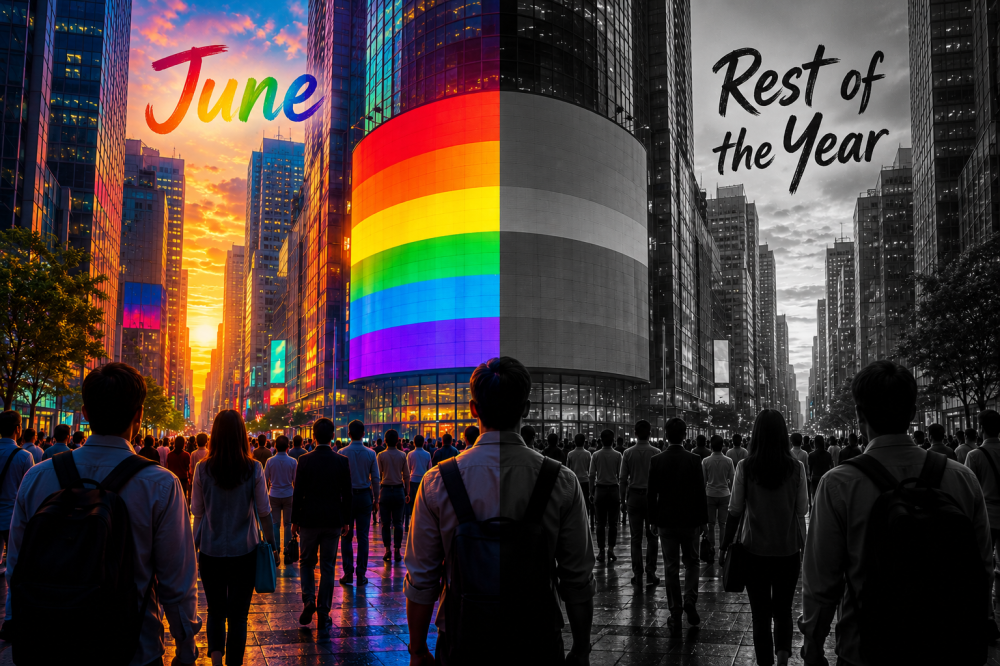
Every June, the world turns rainbow.
Corporate logos change colours. Social media feeds are flooded with messages of inclusion. Panel discussions are organised. Leaders speak about allyship. Employee Resource Groups become visible. Pride flags appear in office lobbies. For one month, it feels as if the world remembers that LGBTQIA+ people exist.
And then July arrives.
The rainbow disappears. The conversations fade. The urgency vanishes. And many of us are left wondering: What exactly changed?
As someone who has spent years working in corporate environments and advocating for LGBTQIA+ inclusion, I often find myself asking a difficult question: If there is no intention to create lasting change, why do we continue to treat Pride as a seasonal campaign?
Because Pride was never meant to be a marketing calendar event.
It was never meant to be a colourful backdrop for social media content.
It was never meant to be a once-a-year celebration that allows organisations to tick a diversity box before moving on to the next business priority.
Pride was born from resistance.
From people demanding visibility, dignity, safety, and equal rights. Yet somewhere along the way, many organisations became comfortable celebrating Pride without confronting the realities that LGBTQIA+ people continue to face every day. The uncomfortable truth is that for many companies, inclusion still begins and ends in June.
The same organisations that proudly showcase rainbow-themed campaigns often remain silent when actual policy conversations arise.
The same organisations that speak about allyship rarely disclose how many LGBTQIA+ employees they employ, retain, promote, or support.
The same organisations that host Pride events may still lack gender-neutral washrooms, inclusive healthcare benefits, transition support policies, or partner benefits for queer employees.
And while a handful of organisations have made meaningful progress since the decriminalisation of Section 377 in India in 2018, they remain exactly that – a handful.
The majority are still catching up. Or worse, standing still.
What concerns me even more is the selective nature of our visibility. Brands are often willing to celebrate LGBTQIA+ people when it is commercially safe. When the message appeals to urban audiences. When it generates engagement. When it earns positive publicity.
But when difficult conversations emerge around policy, legislation, rights, or discrimination, the collective voice becomes remarkably quiet. Consider the recent debates and legislative developments affecting transgender communities.
Where were the large corporate statements?
Where were the industry-wide coalitions?
Where were the influential business leaders who so confidently spoke about inclusion every June?
Many simply remained silent. And silence, too, is a choice.
Perhaps that is why tokenism feels so exhausting. Not because organisations celebrate Pride. Celebration is important. Visibility matters. Representation matters. Stories matter. But visibility without accountability eventually begins to feel performative.
A rainbow logo is easy. Reviewing organisational policies is harder.
A Pride-themed campaign is easy. Building an inclusive workplace culture throughout the year is harder.
Posting support on social media is easy. Standing up publicly when rights are being debated is harder.
That is where real allyship begins.
The measure of inclusion is not what happens in June. It is what happens in January, March, August, and November. It is reflected in hiring practices. In leadership representation. In healthcare coverage. In workplace safety. In reporting mechanisms. In a gender-neutral infrastructure. In the confidence with which an employee can introduce their partner without fear.
Most importantly, it is reflected in whether organisations are willing to continue the conversation when the rainbow is no longer trending. The LGBTQIA+ community does not stop existing after June. Discrimination does not pause for eleven months. Mental health challenges do not disappear when Pride Month ends.
Neither should inclusion.
So perhaps the question we need to ask this Pride season is not how many events we organised or how many rainbow posts we published. Perhaps the real question is much simpler: What will still exist on the first day of July?
Will the policies remain?
Will the commitment remain?
Will the conversations remain?
Will the courage remain?
Because if everything disappears with the rainbow logo, then what we celebrated was never Pride.
It was branding.
And the LGBTQIA+ community deserves far more than that.